Deciding what to see in the Gargano in a few days means choosing among three different landscapes coexisting in 70 kilometres of coastline and as many inland: the mid-mountain hardwood forest, the white-cliff coastline with its coves, and the karst plateau with its stone villages. Monte Sant’Angelo is the ideal anchor point because it sits at the intersection of all three directions. On this page we summarise the main destinations and realistic travel distances as a starting point for planning a three-day itinerary.
The Foresta Umbra
The Foresta Umbra is the vegetal lung of the Gargano National Park. It covers around 10,000 hectares between 300 and 800 metres elevation, with centuries-old beeches, oaks, maples and yews. In 2017 parts of the Foresta Umbra were inscribed on the UNESCO list “Ancient and Primeval Beech Forests of the Carpathians and Other Regions of Europe”, an expanded transnational recognition that protects the oldest beech forests on the continent.
The most practical access points are the Umbra Visitor Centre (small lake, nature museum, ticket office) and the Caritate entrance. Trails are numbered and range from 30 minutes (Lake loop, easy) to four hours (Sfilzi trail, demanding elevation). Roe deer, wild boar and many raptor species are common; the best sightings happen at dawn and sunset.
Vieste
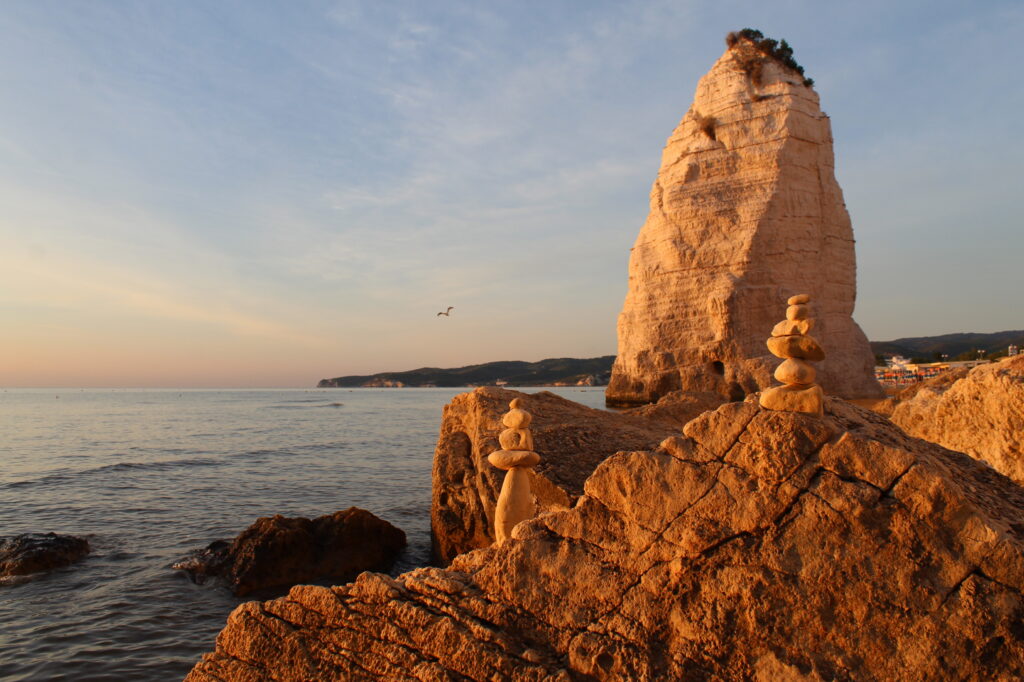
Vieste is the main tourist hub on the Gargano coast. The old town occupies the Punta di San Francesco promontory, with white houses overlooking the Adriatic and the Romanesque cathedral at its centre. The town’s symbol is the Pizzomunno rock, a 25-metre-tall limestone monolith that divides Castello beach from Scialara beach. Vieste lies about 55 km from Monte Sant’Angelo along the SP53; real travel time, between curves and coastal stretches, is just over an hour.
Beyond the beaches, two elements make Vieste worth visiting outside peak season too: the Swabian Castle, built by Frederick II in the 13th century and enlarged in the Aragonese period, and the Chianca Amara, a stone slab where in 1554 the pirate Dragut beheaded the townspeople he could not enslave. A plaque marks the spot in the old quarter.
Peschici
Peschici clings to a cliff plunging into the sea at the northern tip of the promontory. Founded by the Schiavoni in the 10th century, it preserves a street layout of narrow alleys, dome-roofed “casedde” houses and a castle at the highest point. The beach below the village is busy; for more isolated coves, the coast between Peschici and Vieste features a series of trabucchi — old stilt fishing platforms, still active in some cases as restaurants — scattered along the SP52.
The Tremiti Islands as a day trip
The Tremiti archipelago lies about 22 km off the Gargano coast. It is reachable by ferry and hydrofoil from Vieste, Peschici, Rodi Garganico and Manfredonia, plus Termoli (Molise) for those arriving from the north. In high season departures are daily; in low season frequency drops to 2-3 per week and can be suspended in bad weather. The main islands open to visitors are San Domino (the greenest, with sea caves and trails) and San Nicola (the most historical, with the Benedictine-origin Abbey of Santa Maria a Mare). One day is enough to see both.
The coastal lakes: Lesina and Varano
The northern Gargano is closed by two brackish lagoons separated from the sea by thin dune ribbons. Lake Lesina (around 51 km²) is a wetland of international importance under the Ramsar Convention, visited by flamingos, little egrets and grebes. Lake Varano is larger (60 km²) and is known for eel farming and mullet bottarga production. Both lakes are walkable along shoreline roads and offer equipped observation points. They suit travellers looking for landscapes different from the classic rocky coast.
The southern coast: from Mattinata to Manfredonia
South of Monte Sant’Angelo the coast changes character. The SS89 descends towards Mattinata, an agricultural village overlooking the Gulf, and continues to Manfredonia, a port founded in 1256 by Manfred of Swabia. The Baia delle Zagare, one of the most photographed spots on the Gargano, lies between Mattinata and Vieste and is marked by two sea stacks rising from the sand; the beach is accessible only by sea or via the lifts of the private resorts perched on the cliff.
Planning what to see in the Gargano by season
Deciding what to see in the Gargano depends heavily on the season. In spring (April-June) the Foresta Umbra fills with bloom and the wild orchids of the promontory take centre stage: more than 60 spontaneous species recorded, some endemic. It is the time for hiking on the national park trails. In summer (June-August) the coast is the reference: beaches, coves, daily ferries to the Tremiti. In autumn (September-November) the food and wine season opens: olive harvest, grape must, Sant’Egidio apples, Carpinese truffles. In winter (December-March) the Gargano suits slow, cultural travel: sanctuaries, inland villages, the thermal baths of Manfredonia. A reasoned winter plan must factor in the closure of many beach establishments and some coastal trattorie.
The southern coast in detail
Between Mattinata and Manfredonia stretches a sequence of smaller settlements often overlooked: Pugnochiuso, an old 1960s tourist colony in a panoramic position; Vignanotica, a white pebble beach below a limestone cliff, reachable on foot from a parking area on the SS89; Mattinatella, an enclosed bay frequented outside peak season too. The whole area is marked by olive groves running down to the sea, some with centuries-old specimens recorded in the regional registry of monumental olive trees. The south-eastern coast of the promontory ends at Manfredonia, a shipyard and port city founded in 1256 by Manfred of Swabia, whose Swabian-Angevin-Aragonese Castle houses the Daunian National Archaeological Museum.
Lesser destinations for longer stays
- Monte Calvo (1,055 m), the highest peak in the Gargano, reachable by car to the base and then on foot.
- Abbey of Pulsano, 6 km from Monte Sant’Angelo, panoramically set above the Pulsano Valley: monastic life restored in 1997.
- Rignano Garganico, an inland village known for the Paglicci Cave, a Palaeolithic site with rock paintings dated to 26,000 B.C. (visitable by reservation only).
- San Giovanni Rotondo, 25 km away, home to the sanctuary of Padre Pio and the new complex designed by Renzo Piano (2004).
To organise the stops in an orderly way, we suggest starting from the three-day itinerary page and consulting the how to get to Monte Sant’Angelo page for transfers from Foggia and Bari stations. One final note on the most authentic side of what to see in the Gargano: the interior. The villages of San Marco in Lamis, Vico del Gargano, Carpino and Ischitella keep a less touristic daily life, with rural architecture, festivals tied to the agricultural cycle and artisanal production (almonds, Vico IGP almond-stuffed figs, taralli) that round out the classic image of the peninsula.