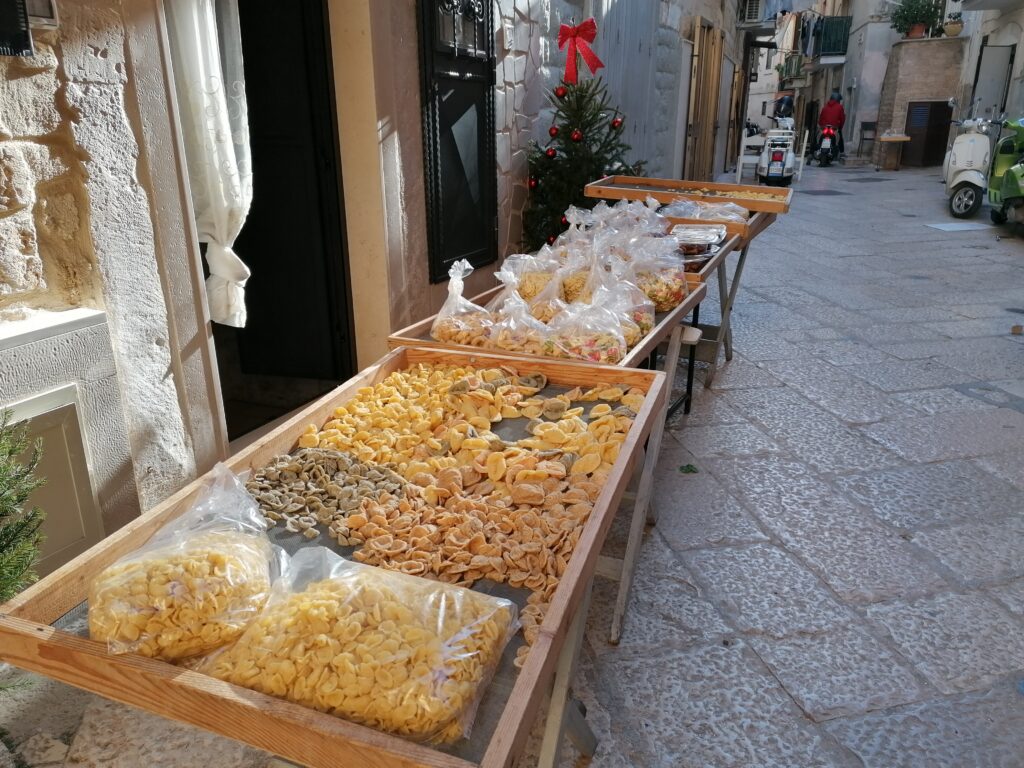
Gargano traditional cuisine forms at the meeting point of three pantries: the Adriatic sea, the limestone plateau where Podolica cows and gentile sheep graze, and the millennial olive grove blanketing the southern slopes of the promontory. The short distance between coast and inland has preserved strongly local dishes: within 30 km you move from the fish broths of Manfredonia to the mutton roasts of Monte Sant’Angelo’s shepherds. On this page we collect the dishes that, in our view, define the region, with reference to the recognised DOP and IGP products.
The fresh pastas
The Gargano shares with the rest of Puglia a tradition of fresh semolina pasta, hand-made and eggless. Three formats are particularly common in promontory restaurants:
Orecchiette
Orecchiette are the flagship dish. In Monte Sant’Angelo you find them served with stewed turnip tops, garlic, chilli and a grating of toasted breadcrumbs: the canonical version of orecchiette with turnip tops. The turnip tops — a local tight-headed variety — are harvested from November to March. Out of season they are replaced with broccoletti or, in some cases, wild chicory. Gargano-style pasta is generally smaller and less concave than the Bari version.
Troccoli
Troccoli are a long pasta with a square cross-section, made by passing the sheet of dough under a ridged rolling pin known as a troccolaturo. They are typical of the whole Daunia and the Gargano. They are served with tomato sauce and fried breadcrumbs, with mutton ragù, or with scampi in coastal restaurants. The artisanal extrusion gives the pasta a surface that holds dense sauces particularly well.
Cavatelli
The local cavatelli — called cicatill in Gargano dialect — are small finger-hollowed gnocchetti. They are traditionally paired with Manfredonia mussels or with cardoncelli mushroom sauce from the Foresta Umbra.
Main courses from the shepherd tradition
Lamb with lampagiuoli
The identity dish of Monte Sant’Angelo is lamb with lampagiuoli: small pieces of lamb stewed with the bulbs of Leopoldia comosa (also known as wild onions or lampascioni). The lampagiuoli — a particular lampascione variety harvested in the Gargano interior — have a slightly bitter aftertaste that balances the fattiness of the lamb. Cooking is long, at least two hours, with extra virgin olive oil, bay leaves and local white wine.
Pecora alla pignata
A mutton stew cooked in a terracotta pot (pignata) with potatoes, tomato, bay and chilli. A mountain masseria dish, today proposed in more or less faithful versions in inland restaurants. Mature mutton is less common today than in the past; some trattorie use young castrato to soften the flavour.
Roast kid
Typical of Easter and the feast of Saint Michael, kid roasted in the oven with potatoes, rosemary and a little garlic is one of the celebratory dishes of Monte Sant’Angelo. It is paired with boiled and sautéed wild greens.
The bread of Monte Sant’Angelo
Among the most characteristic products of the town is the bread of Monte Sant’Angelo, recognised as a Traditional Agri-Food Product (PAT) of the Puglia Region. It is a large loaf — historic sizes reached 5 kg — with a dark crust and dense crumb, made with re-milled durum wheat semolina flour from Puglia and natural sourdough. Traditionally baked in the town’s wood-fired ovens, it kept for a full week. Today some local bakeries continue production in smaller sizes.
Dauno DOP olive oil from the Gargano
The extra virgin olive oil of the promontory is certified as Dauno DOP, “Gargano” sub-denomination. It is produced with the Ogliarola garganica and Coratina cultivars, with a green-grassy aromatic profile, notes of artichoke and almond, and moderate bitter and pungent notes. The Gargano olive groves include centuries-old monumental trees, in some cases listed as environmental heritage. The active mills between Vieste, Vico del Gargano and Monte Sant’Angelo offer visits and tastings, especially from October to December during the olive harvest.
The cheeses: caciocavallo podolico
The Podolica cattle breed, raised free-range on the Gargano plateau, provides the milk for caciocavallo podolico. It is produced only from May to July, when the Podolica grazes the seasonal aromatic herbs. The classic form is pear- or flask-shaped, tied in pairs and hung to age in natural caves for periods ranging from 6 months to 4 years. The very aged caciocavallo (over 24 months) shows notes of toasted hazelnut and black pepper and is one of the most sought-after cheeses in southern Italy.
Other local cheeses
- Cacioricotta: a blend of ricotta and curd cheese, aged 30-60 days, for grating.
- Pecorino del Gargano: made from gentile sheep, with a decisive flavour, aged 4-12 months.
- Burrata: production is mainly in the Bari area, but some Gargano dairies offer it fresh daily.
Coastal fish
Manfredonia, Vieste and Peschici are the reference ports. The most typical dishes are brodetto alla manfredoniana (fish soup with red mullet, scorpionfish, monkfish, mullet, squid, chilli and a little tomato), stuffed mussels, and octopus alla pignata. Cuttlefish stuffed with stale bread, cheese and parsley are a family-feast classic at Easter and Christmas.
The wines
The Gargano produces niche wines from native cultivars. The Cacc’è Mmitte di Lucera DOC denomination lies nearby (inner Daunia); more locally the production runs to Puglia IGT wines from Nero di Troia, Bombino bianco and Nero di Troia rosé blends. Some wineries in Cagnano Varano and Carpino offer visits with tastings.
Sweets and vincotto
The cartellate — strips of thin pastry, fried and dipped in vincotto (cooked grape must) — are the festive sweet, especially at Christmas. Sweet taralli with vincotto, fried pittule and Vico del Gargano almond-stuffed figs are other recurring presences on the table. To organise the food stops within a wider route we refer to the three-day itinerary page; to get your bearings on distances and production centres we refer to the what to see in the Gargano page.
Where to try Gargano traditional cuisine
Gargano traditional cuisine is present, in different versions, in three distinct settings: family-run town trattorie, agriturismo masseria restaurants, and seafront taverns in coastal centres. The first, concentrated in Monte Sant’Angelo, Vico del Gargano, San Giovanni Rotondo and Mattinata, are the reference for inland dishes (orecchiette, lamb, troccoli, kid). The second combine country cooking with farm produce: young caciocavalli, Podolica cured meats, garden vegetables. The third, in Vieste, Peschici and Manfredonia, focus on fish and seafood dishes. For those wanting to dig deeper into a single element, visits to DOP olive mills, Podolica dairies and the wineries of Cagnano Varano and Carpino are the most direct way to understand how Gargano traditional cuisine ties to the land. The village festivals, spread from May to October, complete the picture: from the orecchiette fair to the caciocavallo podolico festival.
Products worth taking home
For travellers who want to continue tasting the Gargano food tradition in their own kitchen, we flag a few reasonable purchases to make locally: a bottle of current-vintage Dauno DOP-Gargano olive oil (check the label), a small wheel of caciocavallo podolico aged 12 months (more manageable than the large forms), a bag of re-milled durum wheat semolina to try orecchiette and troccoli at home, a bottle of artisanal vincotto, and — if the season allows — dried cardoncelli mushrooms gathered in the Foresta Umbra. All products that travel well in a suitcase.