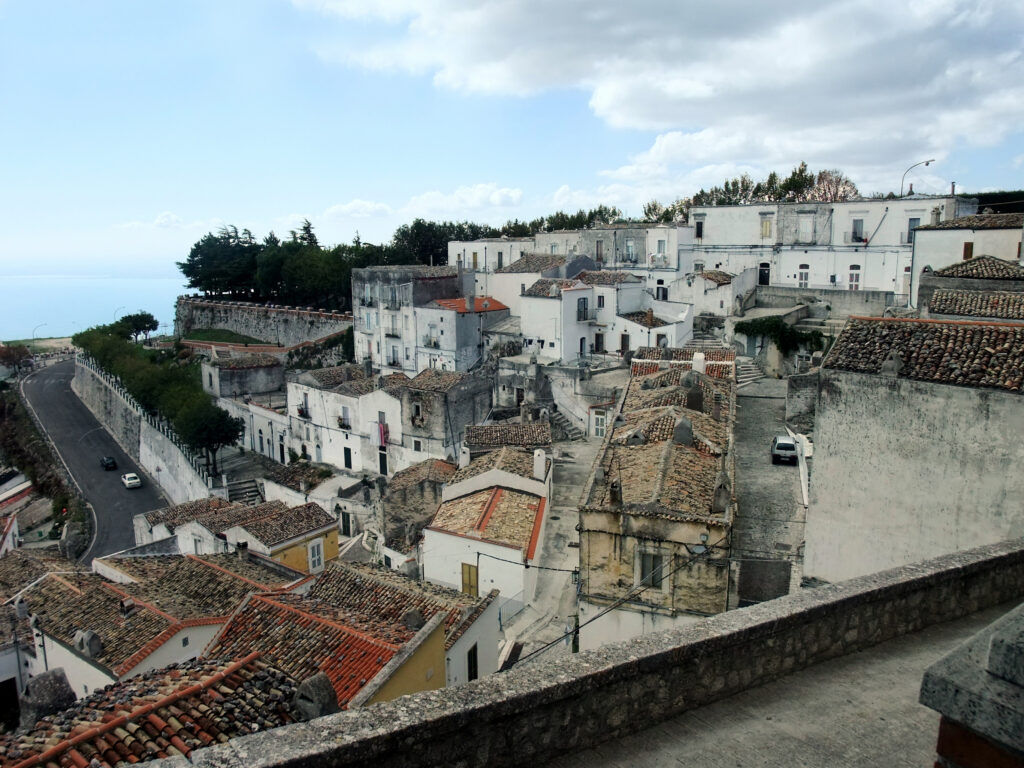
Monte Sant’Angelo sits at 796 metres on the Gargano promontory, poised between the Tavoliere plain and the Adriatic. The town, recognisable by its white roofs and octagonal bell tower, is one of three Italian municipalities on the UNESCO World Heritage list as part of the serial site “The Longobards in Italy. Places of Power (568-774 A.D.)”, inscribed in 2011. This independent guide collects practical, historical and logistical information for anyone planning a trip to Monte Sant’Angelo Gargano, from the pilgrimage to the Sacred Cave through to two or three days exploring the surrounding promontory.
The site is not run by any hotel: it is a self-standing editorial project. The aim is to publish concrete pages, kept current where possible and free of the promotional language that often confuses travellers. When we lack a verifiable data point, we leave it out. Anyone preparing a trip to Monte Sant’Angelo Gargano deserves dry information: distances, opening hours, transport directions, and a few targeted notes on the historical context of the promontory.
Why Monte Sant’Angelo and the Gargano
The Gargano is the easternmost section of mainland Puglia, a limestone plateau projecting roughly 70 kilometres into the Adriatic. Monte Sant’Angelo is its historical and spiritual capital. Three elements justify the trip:
- The Sanctuary of San Michele Arcangelo, in continuous use since the 5th century A.D. and the destination of the Via Sacra Langobardorum.
- The Gargano National Park (established in 1991), which includes the Foresta Umbra, added to the UNESCO list in 2017 among the Ancient and Primeval Beech Forests of the Carpathians and Other Regions of Europe.
- The coast, with Vieste, Peschici and the Tremiti Islands reachable as day trips from Manfredonia or from Vieste itself.
Four pages to find your bearings
We have organised the guide into six thematic sections plus this opening page. Each answers a specific question:
The Sanctuary of San Michele Arcangelo
What to see inside the cave, opening hours, dress code, the meaning of the title “Celestial Basilica” and the history of the apparitions of Saint Michael between 490 and 493 A.D. attested by the Liber de apparitione Sancti Michaelis in Monte Gargano.
What to see in the Gargano beyond Monte Sant’Angelo
The Foresta Umbra, Vieste with the Pizzomunno rock, Peschici clinging to its cliff, the coastal lakes of Lesina and Varano, the Tremiti archipelago. A dedicated page covering day excursions feasible using Monte Sant’Angelo as a base.
Where to stay
A comparison of accommodation types: agriturismi in the surrounding hills, B&Bs in the Junno quarter (the courtyard district of white houses), three-star hotels along Via Pulsano, and pilgrim hostels near the Sanctuary.
Three-day itinerary
A detailed proposal based in Monte Sant’Angelo: day one for the town and the Sanctuary, day two for the Foresta Umbra and Vieste, day three for the Tremiti Islands or a coastal loop from Mattinata to Peschici.
The other two practical pages
The remaining sections address concrete logistical questions. How to get to Monte Sant’Angelo gathers the options by train, bus and car from Foggia and Bari stations, with real travel times and notes on the limited-traffic zone in the historic centre. Gargano traditional cuisine lists the regional dishes — from orecchiette with mutton ragù to lamb with lampagiuoli — with reference to the recognised DOP and IGP products, including Dauno DOP olive oil and Caciocavallo Podolico.
When to come
Peak season on the coast is July-August, when Vieste and Peschici double their population. For Monte Sant’Angelo the calendar runs differently: the Sanctuary is visited year-round but peaks fall around the feasts of Saint Michael (8 May and 29 September). For a less crowded visit we suggest April-May and September-October, when temperatures in town stay pleasant and the Foresta Umbra trails are walkable without the winter snow risk (the 800-metre elevation gives a climate distinct from the coast).
A balanced plan for Monte Sant’Angelo Gargano in these shoulder seasons lets you combine cultural visits in the morning, national park excursions in the afternoon, and dining stops in the evening at the town’s trattorie, without booking pressure.
Useful distances at a glance
| From | To Monte Sant’Angelo | Real travel time |
|---|---|---|
| Foggia station | ~60 km by road | 1 h 30 by SITA bus |
| Bari airport | ~210 km | 2 h 30 by car |
| Vieste | ~55 km | 1 h 15 by car |
| Foresta Umbra (visitor centre) | ~30 km | 40 min by car |
| San Giovanni Rotondo | ~25 km | 30 min by car |
How to use this guide
The seven pages of the site stand on their own but cross-reference each other. You can start from whichever matches the most urgent question: transport, accommodation, what to see, food, itinerary. Each page points to the others where relevant. This homepage works as a reasoned index; it does not duplicate the content of the inner pages.
A note on the name
This guide is called santangelohotel.it for historical reasons tied to the domain. It does not represent any hotel and is not connected to commercial operators. It is an independent editorial project dedicated to Monte Sant’Angelo and the Gargano. For official information on the Sanctuary and the municipal administration we refer to santuariosanmichele.it and the Monte Sant’Angelo town council website.