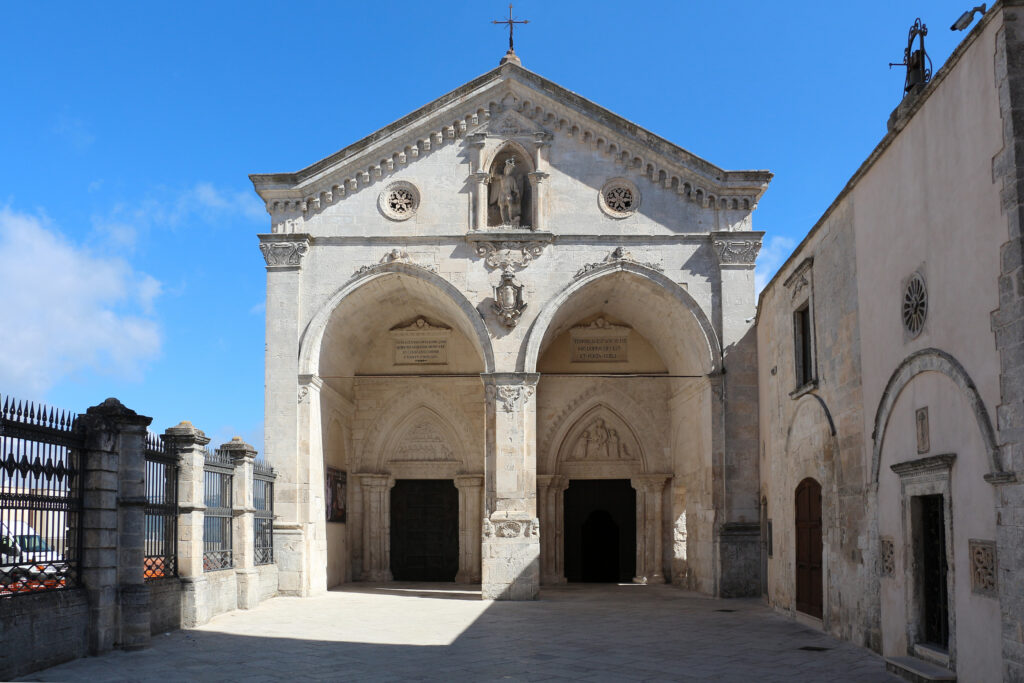
The sanctuary of San Michele Arcangelo Monte Sant’Angelo is the oldest place of Michaeline worship in Western Europe and gave rise to the model for sanctuaries dedicated to the Archangel, from Mont-Saint-Michel in Normandy to the Sacra di San Michele in Val di Susa. The complex is organised around a natural cave in the Gargano limestone bedrock, today reached by descending 86 steps from the level of the town.
Setting of the sanctuary of San Michele Arcangelo Monte Sant’Angelo
The complex stretches across three levels: the outer churchyard with its bell tower, the upper atrium with Gothic-Angevin naves, and the natural cave below. The cave is the liturgical heart of the sanctuary of San Michele Arcangelo Monte Sant’Angelo and is the only cave in Europe that tradition attributes to direct angelic consecration. Understanding the stratigraphy helps read the monument during a visit.
History: from the 490 apparitions to UNESCO recognition
Traditional sources place the first apparition of Saint Michael on 8 May 490 A.D., when, according to the Liber de apparitione Sancti Michaelis in Monte Gargano compiled in the 8th-9th centuries, the Archangel revealed himself to Bishop Laurence Maiorano of Siponto. Two further apparitions in 492 and 493 led to the consecration of the cave, deliberately left without human dedication because — tradition holds — the Archangel had already consecrated it himself.
From the 7th century the Longobards of the Duchy of Benevento adopted Saint Michael as their military patron and funded the expansion of the complex. It is precisely this role during the Longobard period that brought the sanctuary into the UNESCO site The Longobards in Italy. Places of Power (568-774 A.D.) in 2011. In the Middle Ages the sanctuary became the final stop of the Via Sacra Langobardorum, the pilgrimage route that branched off the Via Francigena and continued towards the Holy Land via embarkation at Manfredonia or Bari.
What you see today
The entrance to the Sanctuary of San Michele Arcangelo is marked by the octagonal bell tower commissioned by Charles I of Anjou in 1274. The Gothic doorway opens into the upper atrium. From here the staircase descends towards the cave. Along the descent, on the right-hand wall, you can still see graffiti and inscriptions left by medieval pilgrims in Latin, runic and Greek — one of the richest epigraphic records of European pilgrimage anywhere.
The cave is divided into three natural naves. At the centre stands the marble statue of Saint Michael by Andrea Sansovino, dated 1507. The main altar holds the 13th-century episcopal throne. To the left of the entrance, a perennial spring known as the “stilla” feeds a small fountain: pilgrims have collected its water for centuries.
The Devotional Museum and the excavations
Adjoining the sanctuary is the archaeological route through the early medieval area, with Longobard and Byzantine wall remains. The Devotional Museum displays ex-votos, liturgical vestments and objects connected to the pilgrimage. Admission is generally included in a combined ticket; we recommend checking availability at the time of your visit.
Opening hours and practical information
The sanctuary keeps seasonal hours. As a recurring reference, opening is early in the morning (around 7:30) with an evening close (around 19:30 in high season, earlier in winter). An afternoon break applies in the winter months. Because hours are subject to change and liturgical events take precedence, we recommend checking the sanctuary’s official website before travelling.
Dress code
This is an active place of worship. Modest dress is required: shoulders covered, trousers or skirts at least knee-length. Hats are not permitted inside the cave. The internal temperature stays around 13-15°C even in summer: a sweatshirt or a light scarf makes the visit more comfortable.
Accessibility
Access to the cave is via the staircase. An alternative route with a lift is reserved for visitors with mobility difficulties. It must be requested from the staff at the entrance and is generally available during opening hours. Wheelchairs can be used down to a certain level; the sanctuary staff helps arrange the transfer. The internal cave surfaces are limestone, in some spots damp or slightly slippery: rubber-soled shoes are recommended. Guide dogs are admitted; other pets are not.
How much time to allow for the visit
A complete visit covering the Gothic atrium, the epigraphic staircase, the main cave, the Longobard archaeological route and the Devotional Museum takes around 1 hour 45 minutes. A shorter visit limited to the cave takes 45 minutes. Anyone travelling with an organised group can book official multilingual guides through the Pilgrim Office; alternatively, audio guides in Italian, English, French, German and Spanish are available at the internal bookshop.
The pilgrimage tradition
The key dates in the Michaeline calendar are 29 September (feast of Saint Michael the Archangel in the universal calendar) and 8 May (anniversary of the first apparition, local feast). On these days the town fills with confraternities and parish groups, especially from Campania and Basilicata, in continuity with the historic routes.
A living tradition is that of the compagnie: groups of pilgrims who climb to the sanctuary singing hymns in dialect. Visitors on these dates should expect longer queues to reach the cave. For a quieter experience, weekday mornings in spring and autumn are the calmest moments.
Around the Celestial Basilica
A few minutes’ walk from the sanctuary stand other notable religious and civic landmarks: the Baptistery of San Giovanni in Tumba, a Longobard-era hypogeum also known as the Tomb of Rotari; the Romanesque church of Santa Maria Maggiore; the Norman-Swabian-Aragonese Castle with views over the Gulf of Manfredonia. All reachable on foot. For longer stays we refer to the page where to stay in Monte Sant’Angelo, which describes the options closest to the sanctuary complex.
Three good reasons to plan the visit carefully
Visiting the sanctuary of San Michele Arcangelo Monte Sant’Angelo requires a different kind of planning than a museum. Three points that are often underestimated:
- Religious services take precedence: during masses and celebrations the cave is closed to tourist visits. The weekly schedule is posted at the entrance and available at the Pilgrim Office.
- The elevation change is real: 86 steps down become 86 back up. Anyone with joint problems should consider the lift or plan rest stops.
- Photography inside the cave is restricted: seasonal rules vary; flash is forbidden. In some areas photography is allowed only after asking staff.
Connecting with the rest of the Gargano
For those building the visit into a wider route, the sanctuary of San Michele Arcangelo Monte Sant’Angelo sits in geographical dialogue with other regional religious landmarks: the sanctuary of Padre Pio at San Giovanni Rotondo (25 km), the abbey of Pulsano (6 km, founded in 1129 by Saint John of Matera) and the unfinished sanctuary of Stignano. The four destinations form what locals call the “sanctuary route” of the Tavoliere-Gargano. To plan timings we recommend consulting the page how to get to Monte Sant’Angelo and reading the apparitions history on the Liber de apparitione Wikipedia entry.