A 3-day Gargano itinerary based in Monte Sant’Angelo balances three components: the religious and civic heritage of the town, the nature of the Foresta Umbra and the Adriatic coast. Three nights are the minimum to cover all three landscapes without rushing. Our proposal assumes a rental or private car; travellers using buses can still follow day one and part of day two, skipping the more remote excursions. For transport options see the how to get to Monte Sant’Angelo page.
Day 1 — Monte Sant’Angelo: the town and the Sanctuary
The first day is given to the town. Start from the upper part, near the Norman-Swabian Castle, where parking is more generous. A visit to the Castle takes about an hour: the fortress, built by the Normans in the 11th century, expanded by Frederick II and then by the Aragonese, preserves the Tower of the Giants and a series of exhibition halls. From the ramparts the view sweeps across the Gulf of Manfredonia as far as Barletta.
From here you walk down to the Junno quarter, the courtyard district of white houses, and reach the church of Santa Maria Maggiore (12th century, Romanesque doorway). A few steps further on stands the Baptistery of San Giovanni in Tumba, a Longobard-era hypogeum also known as the Tomb of Rotari. The morning closes with lunch in a trattoria: a good chance to try the orecchiette with turnip tops or the lamb with lampagiuoli described on the Gargano traditional cuisine page.
Afternoon dedicated to the Sanctuary of San Michele Arcangelo. For a quieter visit we suggest arriving at 15:30, after the afternoon break and before the evening services. Once you have descended the 86 steps you enter the main cave. It is worth continuing onto the archaeological route through the adjacent Longobard rooms. The full visit takes 1 hour 30. Close with a walk to the Largo San Francesco lookout, which offers a good sunset view over the plain.
Day 2 — Foresta Umbra and Vieste
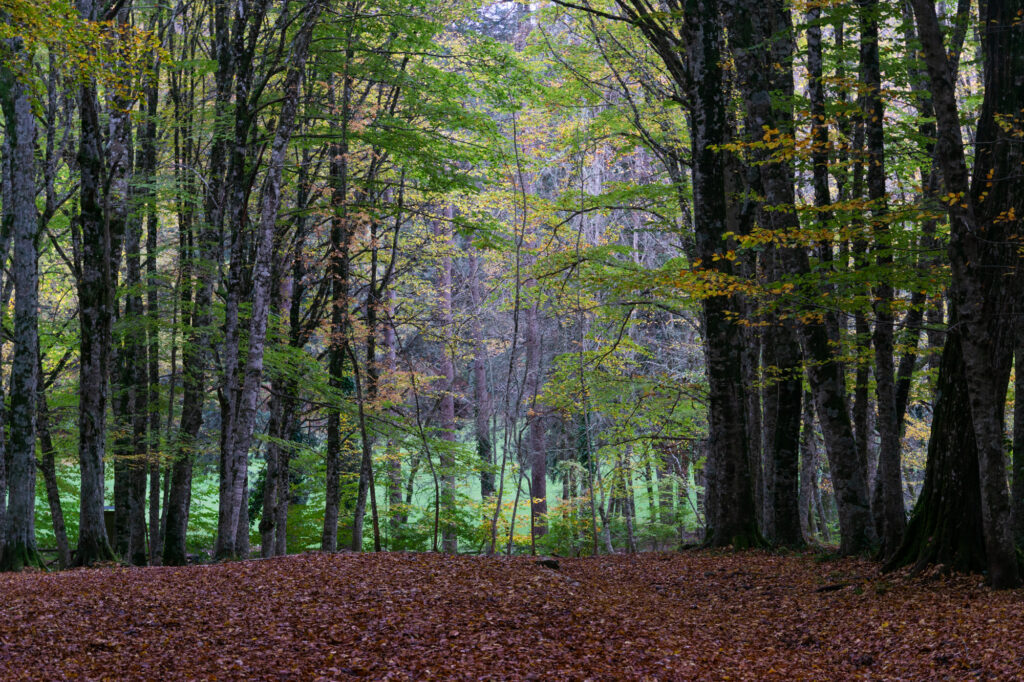
The second day puts the contrast between wooded interior and coast at the centre. Early-morning departure from Monte Sant’Angelo along the SP55 towards San Giovanni Rotondo, then diversion onto the SS272 and SP144 to the heart of the Foresta Umbra. The Foresta Umbra has been on the UNESCO list “Ancient and Primeval Beech Forests” as transnational natural heritage since 2017: in some areas the beech forest reaches 500 years of age.
We suggest the Umbra Lake loop trail (1 hour, modest elevation), with a stop at the Visitor Centre and the small adjoining nature museum. For a longer hike, the trail to the Sfilzi integral reserve (3-4 hours total, demanding elevation) crosses areas with centuries-old yews and hollies. Leaving the marked trails is forbidden: the area is protected as Zone A of the National Park.
After a packed lunch or a stop at one of the equipped picnic areas, descend towards Vieste along the SP53. The road is scenic, with hairpins and ridge stretches. In Vieste we recommend leaving the car in the southern parking areas (Pizzomunno zone) and walking through the old town: the Cathedral, the Swabian Castle, the Chianca Amara, the Vicolo del Bacio. Allow 2 hours. Sunset on the seafront with a view of the Pizzomunno rock. For those with flexibility for a night outside Monte Sant’Angelo, Vieste has more seafront accommodation; see the where to stay in Monte Sant’Angelo page for the comparison.
Day 3 — Option A: Tremiti Islands
The Tremiti archipelago is reachable from the ports of Vieste, Peschici and Rodi Garganico in high season. The hydrofoil crossing takes about an hour; the ferry takes 1 hour 30 to 2 hours. The main shipping lines vary and schedules change sharply by season. We recommend booking the day before and taking the earliest departure (generally between 8:30 and 9:30) to make the most of the day.
Once on San Domino, the main tourist island, you can do the boat tour of the sea caves (Grotta del Bue Marino, Grotta delle Viole, Grotta delle Murene): 2 hours with a local boatman. Lunch on San Domino with fish dishes. Afternoon dedicated to San Nicola, the historic island, with a visit to the Abbey of Santa Maria a Mare (11th century, originally Benedictine, then Cistercian and finally a fortress in the 16th century). Return to Vieste or Peschici on the last departure, generally between 17:00 and 18:30, then back to Monte Sant’Angelo.
Day 3 — Option B: coastal loop from Mattinata to Peschici
For travellers in low season, when Tremiti connections thin out, we propose a coastal loop by car. Morning departure, descending to Mattinata along the SP55 (15 minutes), with a walk on the seafront and a visit to the Museum of Gargano Civilisation (local palaeontology). Continue north along the SS89 with a stop at the Baia delle Zagare to photograph the sea stacks (beach access is not always available outside peak season). Arrive in Vieste for lunch.
Afternoon: the scenic SP52 Vieste-Peschici route with a stop at one of the historic trabucchi. Visit Peschici, a village perched on the cliff over the sea. Return to Monte Sant’Angelo in the late afternoon along the SS693 and SP52: 1 hour 30 of driving. Closing dinner in a Monte Sant’Angelo trattoria.
Why this 3-day Gargano itinerary works
Three elements make the 3-day Gargano itinerary described above feasible. The first: the concentration of attractions within 60 km of Monte Sant’Angelo. The second: the environmental variety — historic town, UNESCO forest, rocky coast, archipelago — which avoids the monotony typical of a single-theme trip. The third: the option to adapt day 3 to the season (Tremiti in summer, coastal loop in shoulder season) without rebuilding the whole stay. The model also works as a 3-day Gargano itinerary for sporting travellers who want to add trekking in the Foresta Umbra and swimming on the coast, and for families who prefer alternating cultural visits and outdoor activities.
A variant with a fourth day
Where availability allows, a fourth day lets you add one of these excursions:
- San Giovanni Rotondo: the sanctuary of Padre Pio and the new Renzo Piano complex (2004).
- Abbey of Pulsano: a Romanesque monastery 6 km from Monte Sant’Angelo, panoramically set above the valley.
- Lake Varano or Lake Lesina: birdwatching and visits to the fishing villages. More details on the what to see in the Gargano page.
- Vico del Gargano: village of almond-stuffed figs and DOP olive oil, with alleys shaded by orange and lemon groves.
Practical tips for the itinerary
- Recommended season: late April-June and September-mid October. July-August the coast is crowded and the heat limits Foresta Umbra excursions to the early morning hours.
- Footwear: boots or light trekking shoes for the Foresta Umbra; comfortable shoes for the paved alleys of Monte Sant’Angelo and Vieste.
- Fuel: refuel before climbing up to Monte Sant’Angelo or before leaving Vieste; in the Gargano interior fuel stations are spaced out.
- Real travel times: add 20% to Google Maps timings for inland routes with curves.
- Connectivity: mobile coverage is good in built-up areas, patchy inside the Foresta Umbra. Download offline maps.